As we saw in the previous posting on this subject, Charles Dickens’s character Ebenezer Scrooge turns out not to have been so much a bad man, but an incomplete person. Once he accepted grace and “converted” to personalism, as Dickens put it, “He became as good a friend, as good a master, and as good a man, as the good old city knew, or any other good old city, town, or borough, in the good old world.”
THE Global Justice Movement Website

This is the "Global Justice Movement" (dot org) we refer to in the title of this blog.
Tuesday, January 11, 2022
Monday, January 10, 2022
JTW Podcast: The Bob’s Red Mill ESOP Story
Two years ago (almost to the day) we went hunting for potato starch to make “karaage,” that is, fried chicken the Japanese way, which requires dredging in potato starch for the very best results. (Trust us. Use potato starch. It’s like a potato chip coating on the chicken.)


Friday, January 7, 2022
News from the Network, Vol. 15, No. 01
What with a couple of paralyzing blizzards in the DC metro area, the year is off to a slow start, which is not made any more interesting, news-wise, by our attempts to avoid partisan politics — we don’t care who does the right thing, as long as somebody does. Be that as it may, here’s what we have for this week:
Thursday, January 6, 2022
Scrooge v. the Socialists
In the previous posting on this subject, we noted how, in contrast to today’s super-rich, and traditional capitalists and socialists, when Ebenezer Scrooge saw the light (and the three spirits), and became charitable, he didn’t call it “justice” and he used his own money. He also didn’t consciously control Bob Cratchit, despite the fact that the system of the time pretty much forced employees into a condition of dependency, which a master could make burdensome or easy. Naturally, many masters really rubbed their employees’ noses in it, as they knew their employees were inferior beings or they would have been in charge . . . right?
Wednesday, January 5, 2022
The Honesty of Ebenezer
In the previous posting on this subject, we noted that Ebenezer Scrooge, the, er, hero (or maybe “victim”?) of Charles Dickens’s 1843 story “A Christmas Carol” was portrayed as a strictly honest man, despite later dramatic characterizations that made him seem like a minor Robber Baron or major sneak thief. Scrooge’s iron rectitude is, in fact, essential to the plot, as otherwise Dickens’s story could have been dismissed (at least within the context of the fictional world) as a lie or a delusion.
Tuesday, January 4, 2022
An Unexpected Christmas Message
No, really, it’s still Christmas. Despite the common belief that “the Christmas Season” starts the day after Thanksgiving (or, for some, after Independence Day) and runs until 9:00 am on December 25, Christmas actually begins at sundown on December 24 and runs for the next dozen days . . . although we’re off the hook regarding gifts, unless you include or hold off until January 6.
Monday, January 3, 2022
JTW Podcast: Guy Stevenson Hungry for More
Okay, this week’s podcast is more than a trifle religiously oriented, but that’s not the reason we’re posting it. If you like you can fast forward to around Minute 10 when Guy Stevenson starts bringing in the Just Third Way and binary economics . . . which is the reason we’re using this podcast.
Friday, December 31, 2021
News from the Network, Vol. 14, No. 52
Today we present the second half of our annual Just Third Way news roundup, with, however, a slightly more cheery current item than we had last week:
Thursday, December 30, 2021
What Sun Tzu Didn’t Tell You
One thing about working in the field of theoretical and practical economics is that you get to hear all the really dumb things people say about money and credit. Almost as bad on occasion, and often worse (if you know anything about military science), are the things you hear about war. That’s why one of the worst movies of all time — at least from a moral point of view — has got to be Wall Street (1987).
Wednesday, December 29, 2021
China’s Contradictory Messages
In a piece in this past Monday’s Washington Post, “China’s Contradictory Messages on Democracy and Hong Kong” (12/27/21, A-15), Keith B. Richburg of the University of Hong Kong noted how the People’s Republic of China is talking out of both sides of its mouth when it comes to democracy. We agree, although not perhaps in the same way as Mr. Richburg.
Tuesday, December 28, 2021
The Very Model of a Modern Chestertonian
Our previous posting on this subject was an expansion of a comment we made on an article, “Catholics and Race in American History,” on the website of the Catholic World Report, a Catholic webzine. We thought we were agreeing with the author, Kevin Schmiesing, but adding a few interesting tidbits we’ve uncovered in our research as well as a little analysis of our own.
Monday, December 27, 2021
JTW Podcast: How to Misunderstand William Cobbett
William Cobbett (1763-1835) Was an English “Radical” politician, journalist and social commentator revered by many “Chestertonians” as “the Apostle of Distributism,” what G.K. Chesterton defined as a policy of widely distributed small property, with a preference for family-owned farms and businesses.
Friday, December 24, 2021
News from the Network, Vol. 14, No. 51
Ordinarily we don’t post anything substantive on Christmas Eve or New Year’s Eve, but (as it does every couple of years or so) both fall on the day we annually reserve for our news roundup for the year. Before we begin with the items from the first half of the year, however, we have some sad news for friends of the Just Third Way:
Thursday, December 23, 2021
Slavery and Moral Relativism
Recently an article appeared on Catholic World Report, “Catholics and Race in American History,” the point of which seemed to be to excuse a presumed lack of action by the Catholic Church in failing to condemn slavery while it was legal, and present a sterling record of condemning racism ever since. The problem with the article was that it missed certain things that would have made the institutional Catholic Church look a lot better than it did, while making individual Catholics look a lot worse.
Wednesday, December 22, 2021
Ryan, Coughlin, and the New Deal
As we saw in the previous posting on this subject, we saw that the New Deal really had nothing to do with any natural law-based approach to social thought, or even “supernatural law” approach, either, if we accept Dorothy Day’s strictures about the dangers of giving “Holy Mother, the State” such overwhelming power.
Tuesday, December 21, 2021
The Right Reverend New Dealer
To this day there are people who insist that the “New Deal” of Franklin Delano Roosevelt not only saved the United States from the Great Depression (ahem, Part III, there having been two previous phases, the first from 1873 to 1878, the second from 1893 to 1898), it was also THE perfect social program and should be duplicated today as in (for example) the so-called “Green New Deal.”
Monday, December 20, 2021
JTW Podcast: 2010 Rally at the Fed
In this week’s podcast we bring you the 2010 Keynote Address given by Norman Kurland, president of the Center for Economic and Social Justice, giving the reasons why we need what we were then calling the Capital Homestead Act, but are now calling the Economic Democracy Act:
Friday, December 17, 2021
News from the Network, Vol. 14, No. 50
As we plan on starting our annual two-part news roundup next week, this is the final “real time” News from the Network for this year. As you can see, not too much is going on that is any different from prior weeks, making it increasingly obvious that we need the Just Third Way of Economic Personalism and the Economic Democracy Act:
Thursday, December 16, 2021
The Role of the State
Recently we saw a tweet or twit or whatever-you-call-’em stating that the terms “student debt” and “medical debt” should be eliminated, as no one should have to go into debt in order to get an education or be healthy. We couldn’t figure out, however, whether the poster meant that people should pay only what they can for schooling and healthcare, or it should all be free, i.e., paid for by somebody else, usually the State meaning everybody else.
Wednesday, December 15, 2021
The War on Private Property
As we saw in the previous posting on this subject, the dominance of Msgr. John A. Ryan over the interpretation of social teaching — achieved by shifting from reason to faith (meaning personal opinion heavily influenced by socialism) — meant that any who opposed socialism were ipso facto heretics instead of simply mistaken or even right when Ryan was wrong. Ryan’s influence even extended to having his students hint that Fulton Sheen was a “traitor to Christ” for saying things that Ryan didn’t want to hear.
Tuesday, December 14, 2021
Ryan v. Sheen
As we saw in the previous posting on this subject, through some very skillful salesmanship and philosophical sleight-of-hand, the whole understanding of “natural law” in the western tradition was overthrown in many circles through the efforts of the Fabian socialists and Msgr. John A. Ryan of the Catholic University of America in the first half of the twentieth century. Nor did matters stop at mere theorizing.
Monday, December 13, 2021
JTW Podcast: Louis Kelso: Economic Theorist
This week’s podcast is an old video from 1983 of an interview with Louis O. Kelso, the lawyer-economist who invented the Employee Stock Ownership Plan (ESOP) and whose ideas were essential to the development of the Economic Democracy Act:
Friday, December 10, 2021
News from the Network, Vol. 14, No. 49
It is becoming increasingly obvious to everyone except those in politics and academia that the Same Old Thing isn’t working. To cut to the chase, until and unless governments adopt the Just Third Way of Economic Personalism and the Economic Democracy Act, matters are only going to get worse:
Thursday, December 9, 2021
It’s Not Socialism Except When It Is
In the previous posting on this subject, we noted that, while the most popular interpretation of “Catholic social teaching” (really the natural law social teaching that applies to everyone, including atheists and anybody else who is a human being, regardless of faith or philosophy or lack thereof and how’s that for a run-on parenthetical?), and even considered “authoritative” — even though it contradicts the very authorities on which it bases its claims.
Wednesday, December 8, 2021
A New Age Economic Program
As we saw in the previous posting on this subject, one of the biggest shifts in thinking that has caused massive amounts of trouble over the past couple of centuries is the shift from reason, to faith in matters pertaining to the natural order. This sounds bad to atheists and agnostics, and good to (some) theists, but the simple fact is that it’s bad for everyone.
Tuesday, December 7, 2021
What Happened to Distributive Justice?
In the previous posting on this subject, we related that Msgr. John A. Ryan changed the basis and understanding of the natural law from reason to faith. The problem there, of course, is that if the natural law is based on reason, it applies to every human being. If it is based on faith, it only applies to those who adhere to the faith that determines the natural law.
Monday, December 6, 2021
JTW Podcast: The Great Game of Business
Today we have a video introducing “the Great Game of Business” and “Open Book Management.” Rather than try to explain here what these are, watch the short video, then correlate it with the Economic Democracy Act:
Friday, December 3, 2021
News from the Network, Vol. 14, No. 48
As of this writing, the Dow down more than 250 points on continuing worries about the effects of the new Omicron COVID-19 strain. Once again it demonstrates the fact that we need to get away from obsessing about what is essentially a fantasy world on Wall Street and focus on the real world of Main Street. To do that we need the Just Third Way of Economic Personalism and the Economic Democracy Act:
Thursday, December 2, 2021
John A. Ryan v. Aquinas
In the previous posting on this subject, we looked at the different roles of faith and reason. To oversimplify somewhat, reason takes first place in matters pertaining to the natural world, while faith takes first place in matters pertaining to the supernatural world. At the same time, neither faith nor reason can contradict one another.
Wednesday, December 1, 2021
Faith AND Reason
As we saw in our last exciting episode, you can’t really understand or critique a system unless you understand the principles of the system. Despite that, many people today declare that they can change the fundamental principles of natural law within an Aristotelian system from reason-based, to faith-based.
Tuesday, November 30, 2021
A Slight Problem with Moral Relativism
Okay, a really big problem with moral relativism, which is the philosophical aspect of both capitalism and socialism. Moral relativism and socialist-capitalism (or capitalist-socialism, not really too much difference atwixt the two) both shift the understanding of the world from what can be proved by logical argument or observed by empirical evidence and go with a “faith”-based personal opinion that ends up being whatever those in power want it to be.
Monday, November 29, 2021
JTW Podcast: The Springfield Remanufacturing Story
In our upcoming book, The Greater Reset from TAN Books, based on our earlier book, Economic Personalism: Property, Power and Justice for Every Person (2020), we talk about the benefits of worker ownership. One of the more successful (to put it mildly) worker-owned companies is Springfield Remanufacturing, which refurbishes engines, the sort of job that’s been moving out of the U.S. for decades.
Friday, November 26, 2021
News from the Network, Vol. 14, No. 47
As of this writing, the Dow has plunged more 1,000 points on news of a new COVID-19 strain in South America. In real terms, of course, it doesn’t mean anything, as a gain or loss in the stock market is only “real” when you sell the shares and lock in a loss or a gain. It does, however, illustrate the fact that we need to get away from obsessing about what is essentially a fantasy world on Wall Street and fovus on the real world of Main Street. To do that we need the Just Third Way of Economic Personalism and the Economic Democracy Act:
Thursday, November 25, 2021

Wednesday, November 24, 2021
You Ain’t Heard NOTHIN’ Yet!
If you’ve seen Monday’s podcast and yesterday’s blog posting, you may be starting to wonder if this is serious or if we made it all up. We can assure you that we’re completely serious and absolutely none of this stuff is made up. As the great biologist J.B.S. Haldane almost sort of said after the editors and science fiction writers got through with it, “The universe is not only stranger than we imagine; it is stranger than we can imagine.”
Tuesday, November 23, 2021
We’re NOT Making This Up, You Know!
Whenever the late, great Anna Russell related something so incredibly illogical or totally bizarre in the plot line of some opera or other, she would utter her tag line, which almost always brought down the house: “I’m not making this up, you know!” Well, neither are we . . . and what we’re saying would absolutely floor anyone who accepts opera plots without batting an eye.
Monday, November 22, 2021
JTW Podcast: America's "Prince of Cranks"
Our upcoming book, The Greater Reset from TAN Books, and based on our earlier book, Economic Personalism: Property, Power and Justice for Every Person (2020), mentions the rather fantastic Ignatius Loyola Donnelly, who was a primary source for Madame Blavatsky's version of theosophy and a major influence on Msgr. John A. Ryan, whose ideas of distributive justice and private property undermined a natural law understanding of those ancient institutions and substituted socialism and fascism for personalist liberal democracy.
Friday, November 19, 2021
News from the Network, Vol. 14, No. 46
If there’s one thing evident from this week’s news items, it’s that most — if not all — of the experts don’t seem to understand money, credit, banking, or finance. Or basic human nature, for that matter. Clearly, if we want to restore sanity, we need the Just Third Way of Economic Personalism and the Economic Democracy Act:
Thursday, November 18, 2021
Icarian Communism
Yes, communism. Although later followers and modern commentators would refer to the system invented by Étienne Cabet as socialism, he insisted that it was communism. To this day there is confusion regarding any meaningful distinction between the terms.
Wednesday, November 17, 2021
That Old Black Magic
If you want to be shunned at the club, tell the truth about a historical falsehood that virtually everyone accepts as unquestionably true. Take, for instance, the origins of socialism and its link to esoteric thought and the Occult, as demonstrated in the voluminous writings of Dr. Julian Strube of Heidelberg University (the one in Baden-Württemberg, not Ohio). Nowhere is this more evident than in the career of Alphonse-Louis Constant.
Tuesday, November 16, 2021
The Church of Saint-Simon
In the previous posting on this subject — the “Democratic Religion” of Socialism — we saw that the ultimate goal of socialism was the complete overturn of traditional society and the implementation of what was usually called “the Kingdom of God on Earth,” a materialist terrestrial paradise. This was usually put in economic terms, frequently confusing people as to what the goal really was.
Monday, November 15, 2021
JTW Podcast: Five Levers of Change
Today we have the final show in the ten-part series on the book, Economic Personalism: Property, Power and Justice for Every Person (2020). This episode covers what we call “the Five Levers of Change”: Education, Politics, Money and Credit, Taxation, and Technology.
Friday, November 12, 2021
News from the Network, Vol. 14, No. 45
This week’s news items focus on the value and role of human labor, particularly its replacement by advanced technology or cheaper foreign labor. The solution is not to raise wages articifically or redistribute, but to institute the Just Third Way of Economic Personalism and the Economic Democracy Act:
Thursday, November 11, 2021
What is “Environmental Justice”?
We’ll be the first to admit that the term “environmental justice” causes something of a kneejerk reaction in us. That’s because, as some of its more vocal adherents insist, it means that “Nature” or “the Environment,” or “Gaia” or something else is a person and therefore has inherent rights that should not be violated.
Wednesday, November 10, 2021
The Democratic Religion
It seems that His Excellency, the Most Reverend Archbishop José H. Gomez of Los Angeles, and current president of the United States Conference of Catholic Bishops, is creating a bit of a stir. Last week, on Thursday, November 4, 2021, he made comments (or “railed” or “ranted,” depending on who’s doing the reporting) branding “new social justice movements” as “pseudo religions” and “dangerous substitutes for true religion.”
Tuesday, November 9, 2021
What is “Social Justice”?
If you google the term “social justice,” you will get a flood of results . . . few (if any) of which have an accurate definition or even description of the virtue. As a result, people generally go away with the same understanding they started with. If they thought social justice is another term for socialism, nothing changed their mind. If they thought that social justice means replacing individual justice with coercive, large-scale “charity” (actually redistribution), little was done to modify their position.
Monday, November 8, 2021
JTW Podcast: (Not So) Secrets of the Fed
This week’s
podcast is an hour-long video on what the Federal Reserve has been doing that’s
not exactly within the scope of its intended purposes . . . which hasn’t been
the case since the New Deal, and was kind of sporadic before then.
Friday, November 5, 2021
News from the Network, Vol. 14, No. 44
Most of what is happening in the world today is the best advertisement possible for the Just Third Way of Economic Personalism and the Economic Democracy Act. The problem is that those who think that they are world leaders (or even just ordinary leaders) aren’t really doing leading or much else that is constructive. What the world needs now is not just love, but a way of realistically implementing justice fulfilled and completed by love:
Thursday, November 4, 2021
The Economic Democracy Act
In the
previous posting on this subject, we presented the theory of binary
economics, which is the economics of the Just Third Way of Economic
Personalism. Today we’ll present what we
think is the best application of the theory, the proposed Economic Democracy
Act.
Wednesday, November 3, 2021
The Un-Capitalist Manifesto
In the
previous posting on this subject, we noted that the Keynesian prescription
for financing economic growth was based on a fallacy: the idea that savings
must be accumulated before new capital can be financed. Examining the period from 1830 to 1930,
however, Dr. Harold G. Moulton of the Brookings Institution found that in each
and every case, periods of rapid economic growth had been preceded not by
reductions in consumption to accumulate savings, but by increases in
consumption that depleted savings!
Tuesday, November 2, 2021
The Formation of Capital
In the
previous posting on this subject, we looked at how financing new capital
formation works with past savings and with future savings. To recap, the past savings technique of
finance means you accumulate savings by decreasing consumption in the past,
while the future savings technique involves increasing production in the
future.
Monday, November 1, 2021
JTW Podcast: Canons of Taxation
In view of the rather confused thinking in the U.S. Congress these days over how best to tax and for what reason, we found this video on the “Canons (or Principles) of Taxation.” The first four are those Adam Smith gave in The Wealth of Nations (1776), while the others were added later by other economists.
Friday, October 29, 2021
News from the Network, Vol. 14, No. 43
Congress and the President are still floundering about the gigantic budget that is getting whittled down day by day as the desperation increases, but nobody has any real answer or alternative . . . except the Just Third Way of Economic Personalism and the Economic Democracy Act:
Thursday, October 28, 2021
A Better Alternative

As we noted in yesterday’s posting, there is a much better alternative to the proposed “Billionaire Tax” or the minimum corporate tax, which would tax corporations whether or not they made any income — another instance of taxing something that doesn’t exist. It starts to sound as if the game plan for the U.S. economy was drawn up by the Greeks . . . the modern Greeks, not those like Aristotle who knew that economic life centers on being productive and supporting human dignity and sovereignty with equality of opportunity and access to the means. He just didn’t work it out very well, but at least he had the right idea.
Wednesday, October 27, 2021
Time for a Tax Reality Check
The so-called “Billionaire
Tax” proposal may be one of the most . . . we’ll say surreal
initiatives in history. How people, whom
we credit with at least normal intelligence, can even consider such a thing has
us completely baffled.
Tuesday, October 26, 2021
Protecting You from Me
In yesterday’s
podcast, we did something unusual, at least for us. We put up two old movie clips from Judgment
at Nuremberg (1961), as well as some newsreel footage of the actual
verdicts being handed down. It must be
admitted that the fictional depiction gives a clearer understanding of the fundamental
issues involved. Of course, in an actual
courtroom, a good judge doesn’t get the kind of scriptwriters that Spencer
Tracy and Burt Lancaster got.
Monday, October 25, 2021
JTW Podcast: Judgment at Nuremberg
This week we’re
doing something a little different for the podcast, presenting two scenbes from
a Hollywood film and an actual historical newsreel of the same event. We hope it serves as a useful reminder that even
when there seems to be no way out of an emergency situation, violating the
rights of a single person, no matter how much you may hate him or her, is never
the answer:
Friday, October 22, 2021
News from the Network, Vol. 14, No. 42
A few items this week, but with
some profound implications. We call your
particular attention to the GoFundMe campaign for Joe Recinos:
Thursday, October 21, 2021
And the Money?
Yesterday we
looked at the
recent spate of strikes and strike-threats that have gotten this month
renamed “Striketober.” Of course, we are
grateful that no one has yet started calling for a “Strike-a-thon,” but no
doubt somebody soon will.
Wednesday, October 20, 2021
Win the Battle, Lose the War?
Seemingly out of
nowhere, American workers are threatening strikes; October
is being labeled “Striketober.”
Largely as the result of the current shortage of workers, labor unions
are pushing for increased pay and benefits, shorter hours, improved working
conditions, and so on. The pandemic has
put organized labor in the best bargaining position it has had in decades, and
public opinion of unions is the highest it’s been since 1965.
Tuesday, October 19, 2021
The Three Types of Liberal Democracy
In the
previous posting on this subject, we promised (or threatened, depending on
your point of view) on the meaning of “liberal democracy.” It turns out that there are three (at least)
different meanings of the term, depending on whether you’re a collectivist, an
individualist, or a personalist.
Monday, October 18, 2021
JTW Podcast: The Great Game of Business
For a bit of a
change of pace, this week’s podcast features an interview with Jack Stack, who
came up with the concept of “The Great Game of Business”:
Friday, October 15, 2021
News from the Network, Vol. 14, No. 41

What with the politicians fighting and the economists arguing, it might seem to you as if no progress is being made . . . and you’d be right — if by “progress” you mean that the politicians have decided to spend more money they don’t have, and the economists have figured out a way to get some of it . . . oops, we mean, present a socio-economic theory and econometric model demonstrating how essential it is that the politicians spend lots of money and that the economists get some of it. In the real world, however, progress continues to be made developing, refining and communicating these ideas:
Thursday, October 14, 2021
A Short Treatise on Sovereignty
As we saw in the
previous posting on this subject, honest or legitimate money can only be
created by backing it with something of value to which the owner has a claim
under private property. Government debt,
which backs most of the global money supply today, represents future or
anticipated tax collections that may actually never materialize because in a
democratic government, taxes are (at least in theory) imposed with the consent
of the governed.
Wednesday, October 13, 2021
Help Joe Walk Again for Economic Justice
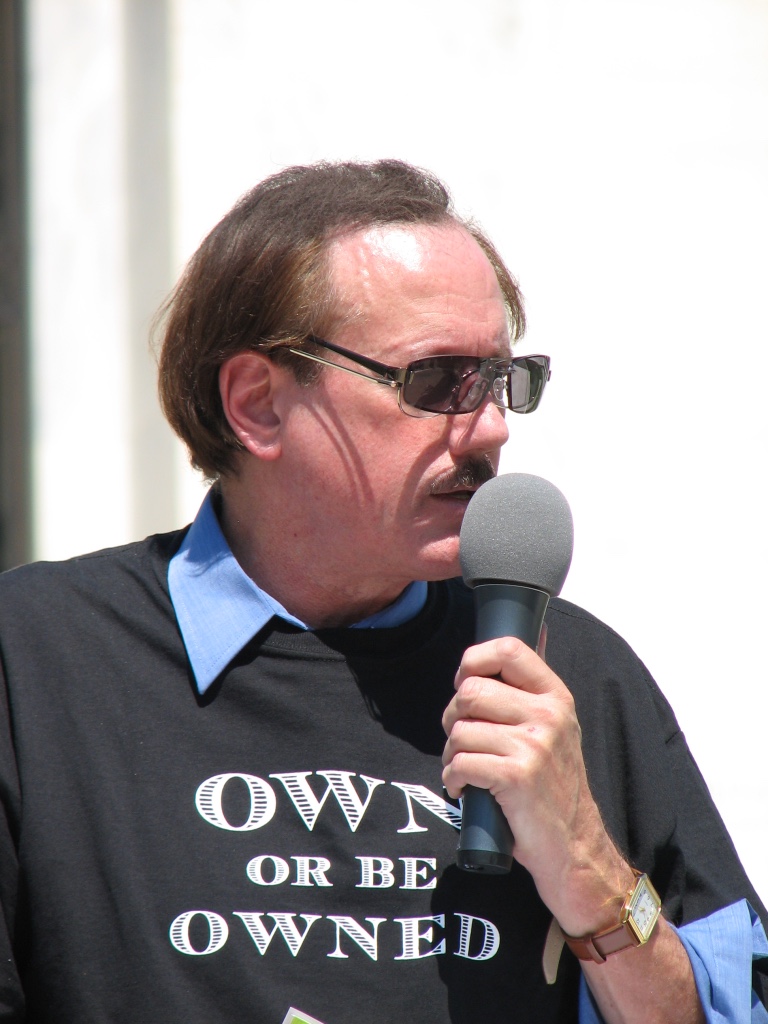
Today’s posting is in support of a GoFundMe campaign to raise money to defray the medical expenses of a “Soldier of Justice” who has devoted his life to creating a better world for everyone: Joe Recinos.
For more than five decades Joe Recinos has worked tirelessly throughout Central and South America, Africa, and Asia to advance a free market approach to economic justice for every person.
Tuesday, October 12, 2021
Hijacking Financial Reform
In the previous posting on this subject, we noted that as the “free land” of the 1862 Homestead Act ran out, the concentration of wealth accelerated. This, however, is pretty much built in to the assumption that new capital formation can only be financed by cutting consumption below what is produced.
Monday, October 11, 2021
JTW Podcast: Disappearing Jobs
Continuing our
series of scare stories about disappearing jobs — and the futility of spending
money on “job creation” — we have this little vignette from 2017. There is, in fact, a seemingly endless supply
of these things, and nobody seems to have any answer except redistribution,
whether we’re talking Great Resets, Universal Basic Income, or hanging the rich
from the nearest lamppost. Nobody seems
to think about the obvious solution:
Friday, October 8, 2021
News from the Network, Vol. 14, No. 40
Interestingly, many of the news
items — if not all of them — revolve around the issue of money and the fact
that few people seem to understand it.
There’s also the problem that people keep putting the cart before the
horse and thinking that money creates prosperity instead of the other way
around. . . .
Thursday, October 7, 2021
The Past Savings Paradox
As we saw in the previous
posting on this subject, the belief that new cap[ital can only be financed
by cutting consumption and accumulating money savings leads to some irresolvable
paradoxes, such as land being both a factor of production and not a factor at
the same time, and that is you cut consumption to accumulate savings to finance
new capital, there is insufficient consumer demand to justify new capital
investment.
Wednesday, October 6, 2021
Ricardo’s Detour
No, we’re not
talking about a Cuban band leader or even someone who plays one on television,
even if we do love Lucy. What we’re
talking about today is the more-than-a-little-confusing way that the economist
David Ricardo explained how to have your cake and eat it, too.
Tuesday, October 5, 2021
How to Sell Out to China
For centuries and
with increasing regularity in our day, the cry has gone up that instead of
taxing ordinary people, the government should stick it to the rich . . . who, after
all, by definition are the ones with money.
Whether we’re talking about the Diggers of the seventeenth century, Huey
Long’s “Share Our Wealth” program, or the current push in the United States to
fund a multiple-trillion dollar budget, it seems that those greedy moneybags
ought to pay their fair share.
Monday, October 4, 2021
JTW Podcast: The Rise of the Machines
No, this is not a
posting about The Terminator . . . unless you’re talking about all the
jobs that are going to be terminated by advancing technology. Nor is it useful to try and go the “Small is
Beautiful,” New Age economics, Fabian socialism simple life scenario. Human beings are toolmakers and users, and if
you abolish advanced technology, it won’t be long before it makes its way back.
Friday, October 1, 2021
News from the Network, Vol. 14, No. 39
All of the antics on Capitol Hill
and Wall Street keep reminding us of just how easily much of the mess could be
cleaned up with the
Economic Democracy Act. So, not to beat a live mule:
Thursday, September 30, 2021
From Need to Greed: The Labor Theory of Value
As we saw in the
previous posting on this subject, the past savings assumption of today’s
mainstream schools of economics and the Great Reset makes it virtually
impossible for most people to be productive by owning capital. As a rule, the past savings assumption limits
access to money and credit to those who are already wealthy.
Wednesday, September 29, 2021
The Obtuseness of Father Brownians
In addition to writing epic poems about Lepanto (the 450th anniversary of which is coming up next week on October 7, read all about it in this book), G.K. Chesterton wrote a series of short stories about “Father Brown” (no first name), a “priest detective,” who appears to have been the first in a more or less illustrious line of amateur clerical sleuths.
Tuesday, September 28, 2021
The Great Collateralization Conspiracy
How was it that
the rich were able to use the Financial Revolution top such great benefit while
the rest of humanity was left behind in the dust? By “Financial Revolution” we mean the shift
in financing of new capital formation from past savings accumulated by reducing
consumption, to future savings accessed by increasing production in the
future. This was made possible by the
reinvention of commercial or mercantile banking in the fourteenth century, and
the invention of central banking in the seventeenth century.
Monday, September 27, 2021
JTW Podcast: No Humans Need Apply
Today’s podcast
is a video that asks the question that Louis Kelso answers with universal
capital ownership: If robots are doing all the work, how are ordinary p[people
supposed to produce something to be able to consume? As Kelso said, “If the
Machine Wants Our Jobs, Let’s Buy It” . . .
Friday, September 24, 2021
News from the Network, Vol. 14, No. 38
It’s astonishing just how many
problems could easily be solved by enacting the Economic
Democracy Act. This week’s news items are definitely a case
in point:
Thursday, September 23, 2021
Future Savings Money
As we saw in the
previous posting on this subject, “usury” is not all profit or interest,
but profit (or interest) taken when no profit (or interest) is due). It is justified by the presumed need to
accumulate savings before financing new capital formation.
Wednesday, September 22, 2021
A Certain Personality
Last week — or
maybe it was really early this week (when something comes in on the weekend it’s
sometimes hard to tell whether it’s late Saturday or early Sunday, especially
when you don’t bother to look) — we got a question from a faithful reader of
this blog regarding our position on persons, particularly that part of it that
defines “person” as “that which has rights.”
As Faithful Reader said,
Tuesday, September 21, 2021
Investment v. Speculation
In the
previous posting on this subject, we pointed out a few foibles of
socialism, noting especially the idea that the only legitimate way to have an
income is a wage system job, which over the past century or so has been
gradually displaced by the idea that people should just get an income whether
or not they have jobs.
Monday, September 20, 2021
JTW Podcast: Importance of Power
We don’t
necessarily agree with everything (or at all on some points) that the speaker and his guest say, but he
raises some interesting points that you might want to be thinking about. And if you don't like this one (who does not necessarily reflect the views of this station), suggest one and send us a link; contact info on the CESJ website, http:www.cesj.org:
Friday, September 17, 2021
News from the Network, Vol. 14, No. 37
Some interesting situations this
week (and every week) that could easily be resolved by enacting the Economic
Democracy Act. This should be increasingly obvious to
everyone as the situations develop:
Thursday, September 16, 2021
Those Whacky Socialists
In the previous
posting on this subject, we looked at the subject of usury, or (in
Aristotelian philosophy) taking a profit where no profit is due. Considering all profit or interest as “usury”
is called “a hasty generalization” in logic, as doing so would violate private
property.
Wednesday, September 15, 2021
Reply to a Relativist, Part II
As we saw in yesterday’s
posting, some people think that taxing an estate or gift is unjust by its
very nature. Others — as we found out
from some vocal readers of this blog — insist that an income tax is inherently
unjust, and yet others declare that all taxation is unjust. Of course, it’s not exactly clear from the,
er, thoughtful remarks we received where government is supposed to get its
funding or whether we’re supposed to have government at all. After all, if government funds itself we get
a tyranny, if there is no government we get chaos.
Tuesday, September 14, 2021
Reply to a Relativist, Part I
The other day we got into a discussion with someone insisting that taxing gifts and inheritance is illegal, immoral, and fattening . . . or maybe just unjust. It doesn’t really matter; this individual just kept insisting that you cannot be for justice and at the same time tax inheritance. In addition, a few comments were made claiming that “person” doesn’t mean “that which has rights,” a somewhat problematical claim for an attorney.
Monday, September 13, 2021
JTW Podcast: Productiveness
“Human capital” is an interesting term. The “Investopedia” website defines it as “a loose term that refers to the educational attainment, knowledge, experience, and skills of an employee. The theory of human capital is relatively new in finance and economics. It states that companies have an incentive to seek productive human capital and to add to the human capital of their existing employees. Put another way, human capital is the concept that recognizes labor capital is not homogeneous.”
Friday, September 10, 2021
News from the Network, Vol. 14, No. 36
At the present time most people seem to be focused (at least in the economic realm) on income, rather than power. Maybe in difficult times that’s what people tend to do, but in the end it does boil down to whether you own, or are owned. That is why we support the Economic Democracy Act as the best alternative of which are aware to things like this:
Thursday, September 9, 2021
But Is It Usury?
In the previous posting on this subject, we noted that the difference between interest per se and usury is that interest is a legitimate sharing of profits on some equitable basis, while usury consists of taking a profit where no profit is due. Complicating understanding of this difference is the confusion between past savings and future savings, and the different types of money derived from each of them.
Wednesday, September 8, 2021
Is Interest Evil?
As we saw in the previous posting on this subject, the type of money determines its proper use. Money that is created by reducing consumption in the past should be used for consumption in the present or the future, not to increase production.
Tuesday, September 7, 2021
Say’s Law and Money
In the previous posting on this subject we took a look at a fundamental error in Keynesian economics, in all of the schools of economics based on the Currency Principle, in fact. That is the claim that production must exist before production can exist — the logical fallacy of reversing cause and effect, specifically, that you must refrain from consuming something before you can produce it.
Monday, September 6, 2021
Happy Capital Ownership Day!
Yes, we know that most people are celebrating Labor Day today, but we think it's more important at this stage to start pushing for capital ownership. After a;;, people produce with both capital and labor, so both should be acknowledged and encouraged
Friday, September 3, 2021
News from the Network, Vol. 14, No. 35
While the weather (at least in Northern Virginia) has taken a turn for the better, the same cannot be said about the world situation. In our opinion, that is not going to improve other than temporarily until and unless the Economic Democracy Act is passed:
Thursday, September 2, 2021
The First Principle of Economics
As we saw in the previous posting on this subject, there are short term expedients that if implemented as permanent solutions impose a condition of dependency — slavery — on the great mass of people. This is not to say that such things as stimulus payments, redistribution, job creation, full employment, and so on, are not essential at times, but they are not the solutions that so many people seem to think.
Wednesday, September 1, 2021
Mandating Virtue
As we saw in the previous posting on this subject, the principal way in which people today can be fully productive members of society (and the economy) is to own capital as well as labor. Of course, that only matters if you view all people as fully human instead of lesser beings or things to be taken care of.
Tuesday, August 31, 2021
Full Participation
Say’s Law of Markets is usually summarized as “Production equals income, therefore, supply generates its own demand, and demand, its own supply. Unless, however, you understand or even are just generally familiar with the full explanation of Say’s Law, it’s likely that you will either misunderstand it or reject it outright.
Monday, August 30, 2021
JTW Podcast: Mortimer Adler on the (U.S.) Constitution
This week we feature “Great Books” philosopher Mortimer J. Adler speaking on the United States Constitution of 1787. Adler taught “Philosophy of Law” at the University of Chicago law school, and William Winslow Crosskey (Politics and the Constitution in the History of the United States, 1953) taught “Constitutional Law” there.
Friday, August 27, 2021
News from the Network, Vol. 14, No. 34
We hate to keep sounding the same note all the time, but many of the problems the world is currently facing would not even be a blip on the radar if the Economic Democracy Act had been passed when it was first proposed, whether then-Governor Reagan’s call for an “Industrial Homestead Act,’ or even Louis Kelso’s 1967 Accelerated Capital Expansion Act. No, it’s not a panacea; we’d still have problems, but they would be of a more manageable size. Until then, however:
Thursday, August 26, 2021
Redefining Humanity
As we saw in the previous posting on this subject, redefining a natural right means that you are, in effect, redefining what it means to be human. That’s because natural law is based on human nature, so redefining its principles effectively redefines what it means to be human.
Wednesday, August 25, 2021
The Problem of Private Property
As we saw in the previous posting on this subject, quite a few people in the world don’t really know the legal definition of “person” . . . although they probably think they do. That can cause one or two (billion) problems.
Subscribe to:
Posts (Atom)